
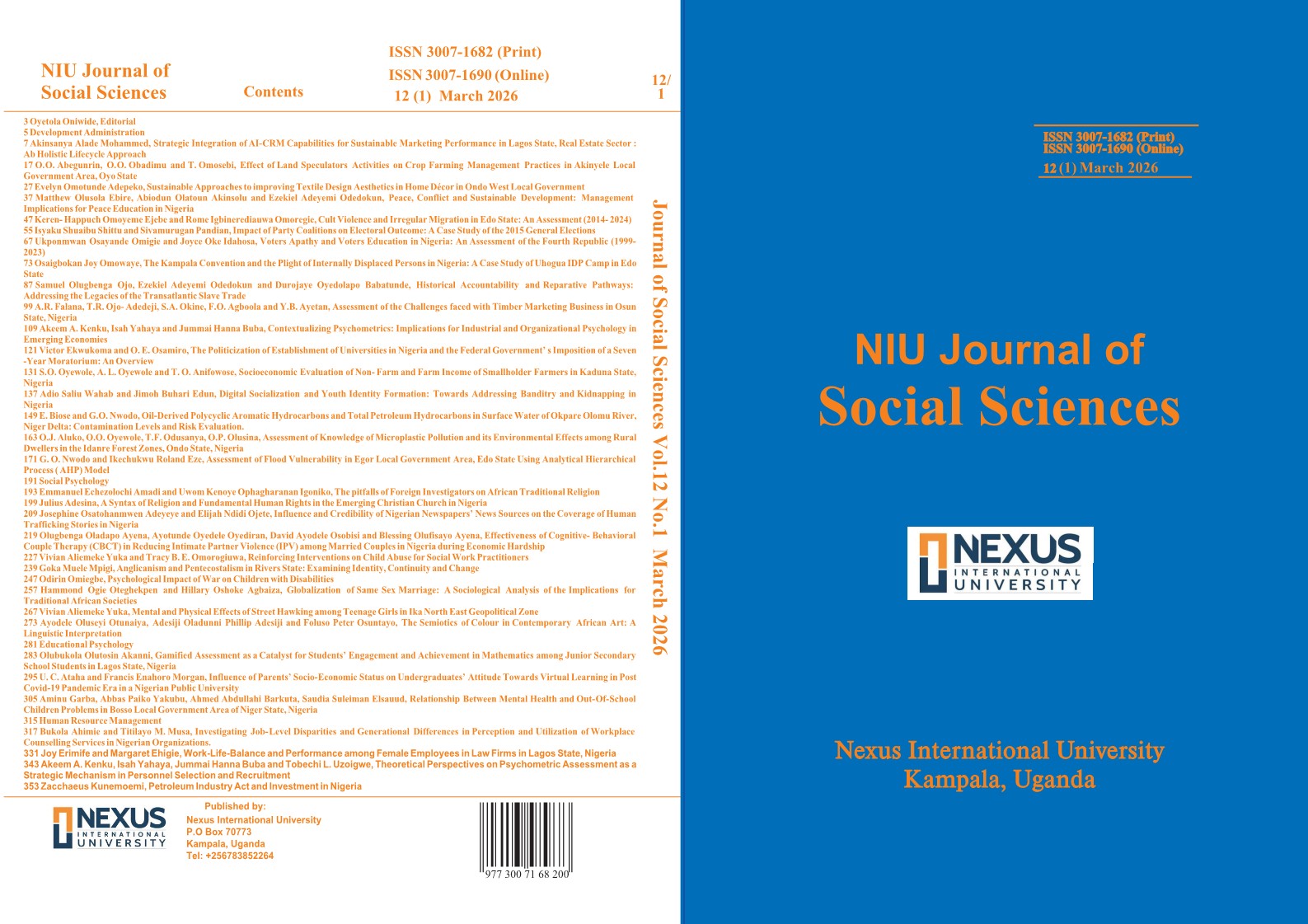
The Politicization of Establishment of Universities in Nigeria and the Federal Government’s Imposition of a Seven-Year Moratorium: An Overview
Abstract
The proliferation of universities in Nigeria has been largely driven by political considerations rather than educational needs or national development goals. This trend has resulted in the establishment of new institutions amidst chronic underfunding, infrastructural decay, poor staff welfare, and frequent industrial unrest in existing universities. Despite the critical role of universities in national development—through teaching, research, and community service—the Nigerian higher education sector struggles with overstretched resources, inadequate facilities, brain drain, and declining academic standards. Between 2020 and 2025 alone, 137 new universities were established, pushing the total to 307, many of which were created without proper planning or funding. The Federal Government’s recent imposition of a seven-year moratorium on the establishment of new tertiary institutions is thus a welcome corrective measure. This paper examines the historical evolution of universities in Nigeria, highlights the consequences of unchecked expansion, and situates the moratorium within the broader context of university education and national development. It argues that meaningful reform must focus on consolidating and strengthening existing institutions through improved funding, infrastructural development, staff welfare, and rigorous regulatory oversight. The paper concludes that without addressing the systemic issues of underfunding and mismanagement, further expansion will continue to undermine the quality, relevance, and carrying capacity of Nigerian universities.
|
Copyright © Nexus International University. All rights reserved. Apart from fair dealing for the purpose of research or private study, or criticism or review, and only as permitted under the Copyright Art, this publication may only be produced, stored or transmitted, in any form or by any means, with prior written permission of the Copyright Holder. |

